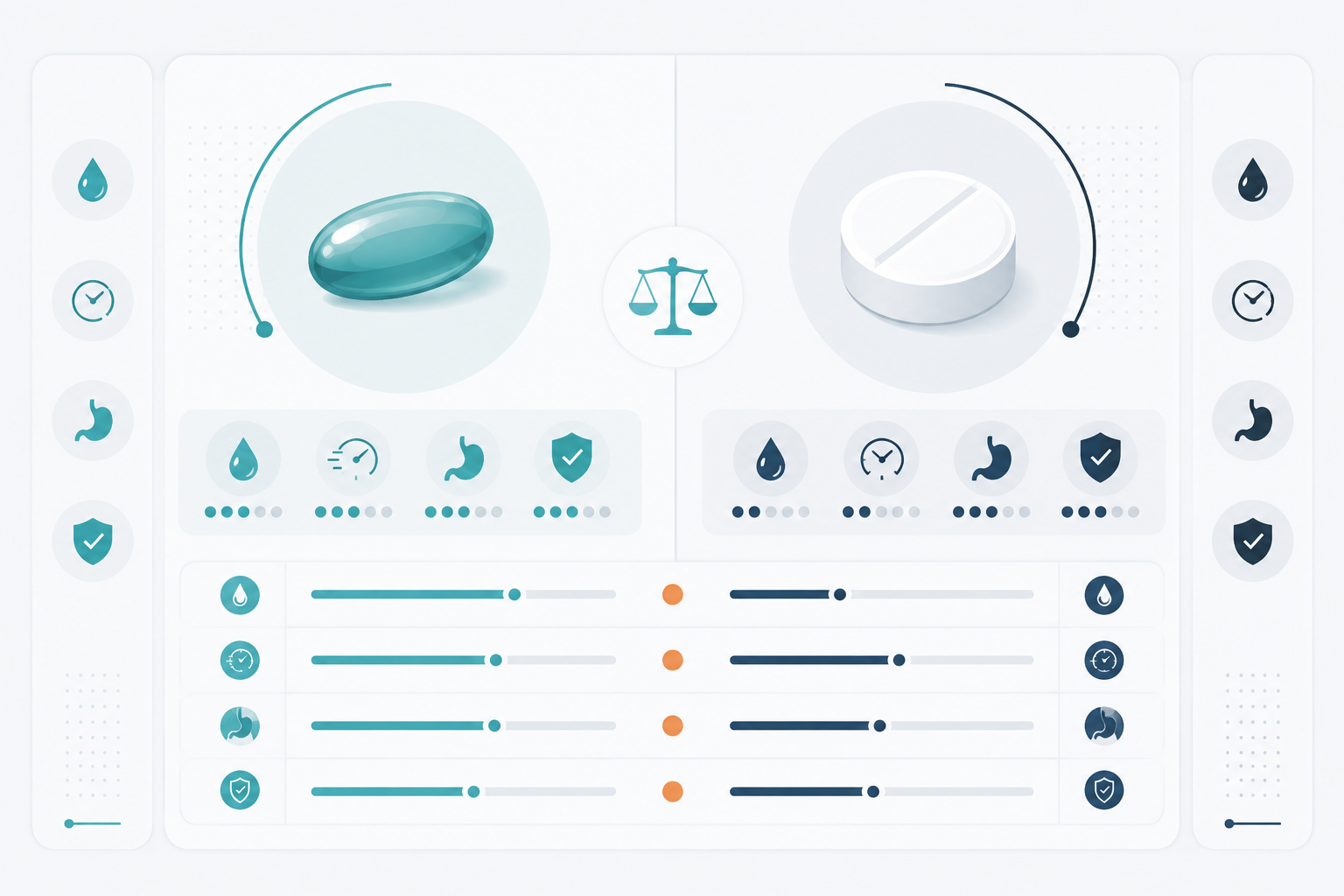
The formulation of vardenafil directly shapes how fast the effect begins, how strong it feels, and how consistently it performs. Soft tabs dissolve sublingually, bypassing part of first‑pass metabolism and delivering a rapid onset with noticeably higher bioavailability — ideal for users who want fast, reliable responsiveness even when timing is tight. Standard tablets rely on gastrointestinal absorption, producing a predictable but slower onset and showing sensitivity to food, especially heavy or high‑fat meals that can delay or weaken the effect.
Soft tabs suit users who prioritize speed, stronger peak intensity, and stability across variable conditions. Tablets are better for those who prefer a classic, gradual effect profile or want easier dose‑splitting options, supported by guidance in Splitting Tablets. If the effect feels inconsistent or weaker than expected, structured troubleshooting is available in Weak Effect and timing optimization strategies in Maximize Effect.
For advanced fine‑tuning — including faster‑acting ODT pathways — see ODT Optimization, helping you choose the most effective form for your physiology and performance goals.
The two primary forms of vardenafil — soft tabs and standard tablets — differ significantly in how they are absorbed, how quickly they begin working, and how stable their performance remains across real‑world conditions. Soft tabs dissolve sublingually, entering systemic circulation without relying on gastrointestinal transit. This mechanism bypasses part of first‑pass metabolism, resulting in faster onset and higher bioavailability. Tablets, by contrast, depend on digestive absorption, which produces a slower, more gradual onset and makes the effect more sensitive to food intake, especially heavy or high‑fat meals that can delay or weaken the response.
These absorption differences directly influence effect strength and stability. Soft tabs typically deliver a sharper, more predictable peak because their pharmacokinetics are less affected by meal timing and gastric variability. Tablets may feel smoother but can fluctuate more between doses, particularly in users who experience inconsistent results or report a weak effect when taken after food. For most users, soft tabs offer a more reliable and faster‑acting profile, while tablets remain a classic option for those who prefer traditional dosing, slower onset, or easier dose‑splitting.
Overall, choosing between soft tabs and tablets depends on whether speed, stability, and bioavailability are priorities, or whether a conventional, slower‑building effect better matches personal physiology and dosing habits.
| Feature | Soft Tabs | Tablets |
|---|---|---|
| Onset speed | Fast | Standard |
| Bioavailability | High | Medium |
| Food sensitivity | Low | High |
| Alcohol sensitivity | Medium | High |
| Stability | High | Medium |
Onset speed is one of the most noticeable differences between vardenafil soft tabs, standard tablets, and ODT formulations. Soft tabs dissolve directly in the mouth, allowing the active ingredient to enter systemic circulation without waiting for gastric processing. This sublingual pathway shortens the pharmacokinetic delay and reduces exposure to first‑pass metabolism, producing a faster and more predictable onset. Tablets, by contrast, must pass through the stomach and small intestine before absorption begins, making their onset slower and more sensitive to timing mistakes — especially when taken after heavy meals, as explained in Timing Mistakes.
The form you choose directly affects how quickly you can expect results. Soft tabs typically activate faster than tablets because they bypass digestive variability. ODT formulations go even further: they dissolve instantly and deliver the fastest onset among all forms, making them ideal for users who struggle with slow or inconsistent responses. For individuals who value rapid readiness, soft tabs and ODT provide a clear advantage. Users who prefer a classic, gradual onset or who follow structured timing routines may still find tablets suitable, though they require more careful coordination with meals and alcohol.
Fast‑onset forms are especially beneficial for users with unpredictable schedules, those who want minimal waiting time, or those who have previously experienced delayed activation with tablets. For advanced optimization, ODT‑specific strategies are covered in ODT Optimization.
| Form | Onset Speed | Timing Sensitivity | Best For |
|---|---|---|---|
| Soft Tabs | Fast | Medium | Quick results |
| Tablets | Standard | High | General use |
| ODT | Very fast | Low | Nonresponders |
Food interaction is one of the strongest differentiators between vardenafil tablets, soft tabs, and ODT. Standard tablets rely on gastrointestinal absorption, meaning any factor that slows gastric emptying — heavy meals, high‑fat foods, alcohol — can significantly delay onset and weaken the effect. This is why many users experience reduced intensity or inconsistent results after eating, a pattern explored in Food Mistakes. Soft tabs, which dissolve sublingually, show moderate sensitivity: while food can still influence systemic absorption indirectly, the impact is far smaller compared to tablets.
ODT formulations demonstrate the lowest food sensitivity because they dissolve instantly and bypass most digestive variables. Their absorption pathway is more stable, making them ideal for users who frequently take vardenafil after meals or who struggle with weak post‑meal effects. Tablets, on the other hand, often require strict timing — ideally on an empty stomach — to achieve optimal strength. Soft tabs offer a middle ground: more forgiving than tablets but not as resistant to food interference as ODT.
Understanding how food affects each form helps users choose the most reliable option for their lifestyle. Those who prefer spontaneous use or often take doses after meals typically benefit from soft tabs or ODT. Users who follow structured timing routines may still prefer tablets, though they must avoid common food‑related mistakes. For maximizing post‑meal performance, additional strategies are available in Maximize Effect.
| Form | Food Sensitivity | Effect Strength After Meal |
|---|---|---|
| Tablets | High | Weak–moderate |
| Soft Tabs | Medium | Moderate–strong |
| ODT | Low | Strong |
Alcohol has a disproportionately strong impact on vardenafil tablets because they rely on gastrointestinal absorption. When alcohol slows gastric emptying and alters hepatic metabolism, tablets face a double penalty: delayed absorption and increased first‑pass reduction. This combination often leads to noticeably weaker effects, especially in users who already struggle with a weak effect or inconsistent activation. Soft tabs, which dissolve sublingually, bypass much of this digestive interference, resulting in only moderate sensitivity. Their onset may slow slightly, but the overall effect remains more stable compared to tablets.
ODT formulations demonstrate the lowest alcohol sensitivity. Because they dissolve instantly and avoid most gastrointestinal variables, their pharmacokinetic profile remains stable even when alcohol is present. This makes ODT ideal for users who frequently combine vardenafil with social drinking or who experience significant strength loss with tablets. Tablets, meanwhile, require stricter timing and minimal alcohol exposure to maintain predictable performance — a challenge for many real‑world scenarios, as outlined in Alcohol Mistakes.
Understanding how alcohol affects each form helps users choose the most reliable option for their lifestyle. Those who drink occasionally or socially often benefit from soft tabs or ODT, while tablet users must be more cautious to avoid performance drops. If alcohol consistently weakens the effect, switching forms may offer a more stable experience.
| Form | Alcohol Sensitivity | Effect Strength | Stability |
|---|---|---|---|
| Tablets | High | Weak | Low |
| Soft Tabs | Medium | Moderate | Medium |
| ODT | Low | Strong | High |
Strength and stability vary significantly across vardenafil forms due to differences in absorption pathways and sensitivity to external factors. Soft tabs generally deliver stronger and more consistent effects because they dissolve sublingually and avoid the digestive variability that weakens tablets. Their higher bioavailability translates into a sharper peak and more reliable performance, especially for users who value fast activation and stable intensity. Tablets offer a classic, moderate effect but are more vulnerable to fluctuations caused by food, alcohol, and timing mistakes.
ODT formulations outperform both soft tabs and tablets in stability. Their rapid dissolution and minimal sensitivity to meals or alcohol make them the most predictable option across diverse conditions. Users who frequently experience inconsistent results or weak activation with tablets often find ODT to be the most dependable alternative. Soft tabs remain the balanced middle ground: strong, fast, and stable enough for most users without requiring the precision that tablets demand.
Choosing the right form depends on whether strength, stability, or convenience is the priority. For users who want maximum reliability, ODT is the top performer. Those who prefer fast onset and strong intensity typically choose soft tabs. Tablets remain suitable for general use when timing is controlled and external factors are minimized. For optimization strategies, see Maximize Effect and advanced ODT guidance in ODT Optimization.
| Form | Effect Strength | Stability | Best For |
|---|---|---|---|
| Tablets | Moderate | Medium | General use |
| Soft Tabs | Strong | High | Quick onset |
| ODT | Very strong | Very high | Nonresponders |
Selecting the right vardenafil form depends on your goals, timing habits, and sensitivity to external factors like food and alcohol. Tablets suit users who prefer a traditional, gradual effect and follow structured timing routines. They work best when taken on an empty stomach and without alcohol, making them a good fit for predictable schedules. Soft tabs are ideal for users who want faster onset, stronger intensity, and more stability across real‑world conditions. Their sublingual absorption makes them more forgiving of timing mistakes and meal variability.
ODT formulations are the top choice for users who need maximum reliability or who have previously experienced weak or inconsistent results with tablets. Their very fast onset and minimal sensitivity to food or alcohol make them especially effective for nonresponders. If you frequently encounter timing issues, ODT offers the most stable performance without requiring strict preparation.
To refine your choice further, consider whether you need easier dose adjustments, faster activation, or stronger peak intensity. Tablet users who want more flexibility can explore Splitting Tablets. Those aiming for stronger or more consistent effects can review optimization strategies in Maximize Effect. For users deciding between forms based on dose behavior, structured guidance is available in Best Dose.